Ran the latest alpha version of StarCluster 3 on Saturday. Klaxon was up from Florida, and was absolutely stellar as an alien plant-lizard doctor. We were using the StarRisk mechanics and hit an unexpected snag. Attempting anything with a +1 or +2 skill was ridiculously difficult! This didn't happen last time!
Then it hit me - this mechanic was intitially tested with In Harm's Way: StarCluster characters, who not only have higher attributes, but have many more Edges due to their training. What was nicely difficult for them became all but impossible for civilians. I immediately reset the difficulties, and things went fine from that point on. Stupid problem, simple fix! With the IHW:SC characters, I was more worried about the high end getting crazy. The new difficulties will work for either game now - somewhat easier for IHW:SC characters, but much more possible for SC3 characters.
The players plans to play as a medical soap - a la Gray's Anatomy - hit the immovable rock of only having one female doctor, and no female mercs. They *really* should have thought that one out! I think they will shift it more towards MASH eventually, based on last night's session...
-clash

Monday, July 12, 2010


Sunday, July 11, 2010
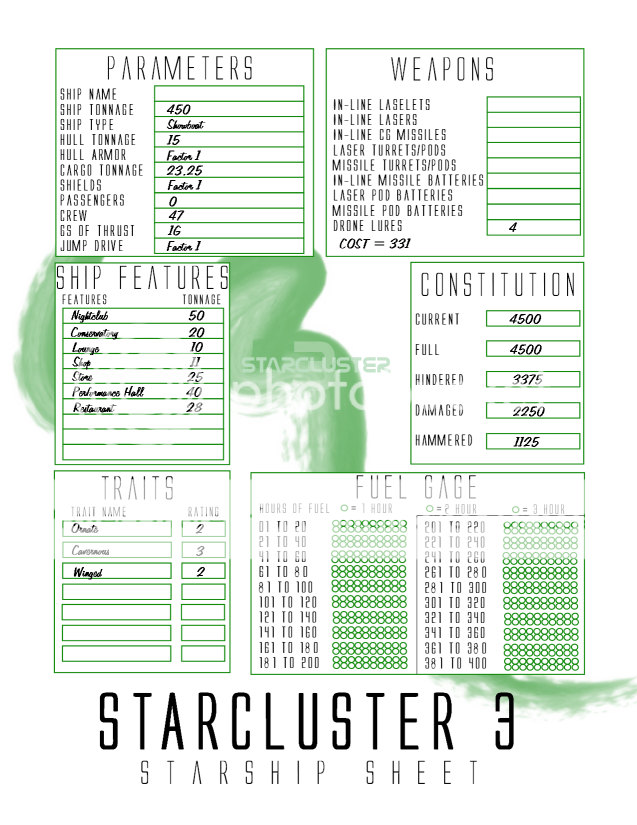
Sample Ship from StarCluster 3E - Showboat
This is a sample ship from StarCluster 3, a showboat, bringing plays and performances to far-flung colonies and affiliates who would otherwise never see such. The crew are mostly also performers of one type or another, pulling double duty.
The ship has a Performance Hall, seating 160 with balconies, with a Prop Room, a 2 story Stage, 5 Dressing Rooms, lighting, and sound. There are also a small Shop with souveniers, a larger Store with more substantial items for sale, a Restaurant with seating for 50, and a big Nightclub seating 100.
The ship carries no armament except for 4 Drone Lures - slow missiles which mimic the sensor signature of the showboat. Shields and armor are minimal - this ship is not meant to stand and fight. The ship is, of course, ornate and showy without being particularly comfortable. This ship masses a touch more than a loaded 747, but being made of much lighter plasteel, it is considerably larger.
Here is the ship sheet for the showboat:

-clash
The ship has a Performance Hall, seating 160 with balconies, with a Prop Room, a 2 story Stage, 5 Dressing Rooms, lighting, and sound. There are also a small Shop with souveniers, a larger Store with more substantial items for sale, a Restaurant with seating for 50, and a big Nightclub seating 100.
The ship carries no armament except for 4 Drone Lures - slow missiles which mimic the sensor signature of the showboat. Shields and armor are minimal - this ship is not meant to stand and fight. The ship is, of course, ornate and showy without being particularly comfortable. This ship masses a touch more than a loaded 747, but being made of much lighter plasteel, it is considerably larger.
Here is the ship sheet for the showboat:
-clash
Friday, July 9, 2010
One Of These Days
This is a list of games I want to write - one of these days!
In Harm's Way: Pigboats
This is a WWII submareine game. In my opinion, a submarine crew is ideal for roleplaying in general, and the IHW mechanics in particular. I've been researching it for several years. I have a bunch of resources which will help me. I have an idea of how I want to model submarine movement. This one is extremely probable, maybe after Outremer is done.
In Harm's Way: Scum of the Earth
This is a Napoleonic Army game. As time goes on, this gets less and less likely. At one time this was a sure thing, but I may never actually do it. I think when Duty and Honor came out, my enthusiasm for the project took a nosedive.
Glorianna
Glorianna is a StarCluster game, set on an extremely high tech planet ruled by a cloned Queen. This has been in the works for years, and I have done a *lot* of background for it, even to running two campaigns on Glorianna, but my will to do it is slowly eroding away. I think I need an enthusiastic collaborator...
The Tools of Ignorance
My baseball game. I have some ideas on how to structure this. It will be a radical extension of what I am doing now - the players will create and run their own ball club, and there will be troupe play for example - into a new area. I have wanted to do this forever. The title may change, but currently I like it. The Tools of ignorance are a catcher's equipment, and the phrase is conciously ironic, as the catcher is usually the smartest guy on the team.
-clash
In Harm's Way: Pigboats
This is a WWII submareine game. In my opinion, a submarine crew is ideal for roleplaying in general, and the IHW mechanics in particular. I've been researching it for several years. I have a bunch of resources which will help me. I have an idea of how I want to model submarine movement. This one is extremely probable, maybe after Outremer is done.
In Harm's Way: Scum of the Earth
This is a Napoleonic Army game. As time goes on, this gets less and less likely. At one time this was a sure thing, but I may never actually do it. I think when Duty and Honor came out, my enthusiasm for the project took a nosedive.
Glorianna
Glorianna is a StarCluster game, set on an extremely high tech planet ruled by a cloned Queen. This has been in the works for years, and I have done a *lot* of background for it, even to running two campaigns on Glorianna, but my will to do it is slowly eroding away. I think I need an enthusiastic collaborator...
The Tools of Ignorance
My baseball game. I have some ideas on how to structure this. It will be a radical extension of what I am doing now - the players will create and run their own ball club, and there will be troupe play for example - into a new area. I have wanted to do this forever. The title may change, but currently I like it. The Tools of ignorance are a catcher's equipment, and the phrase is conciously ironic, as the catcher is usually the smartest guy on the team.
-clash
Wednesday, July 7, 2010
The Uses of Caricature
One of the most useful new concepts in IHW:SC and SC3 is Cultural Traits. Each world has its own culture, and each culture has traits. The culture from Rienhart's World might be Aggressive 2, Subtle 3, Arrogant 1, and Impatient 1. This group of traits, then, represents a caricature of a person from Rienhart's World. Individuals, of course, may vary widely from this caricature. They may in fact exhibit none of these traits, but on a bell curve, these traits stand out as most representative of this culture.
This gives the Player and GM both a baseline to construct a character, NPC or PC. Rather than working cold, one can take the baseline as the default, then decide if and how the individual deviates from it. It not only helps constructing the character's personality, but also gives an indication of how that character fits into that culture. Someone with slight variations should have little problems, but someone with large differences, especially oppositional differences, might be very out of place.
- clash
This gives the Player and GM both a baseline to construct a character, NPC or PC. Rather than working cold, one can take the baseline as the default, then decide if and how the individual deviates from it. It not only helps constructing the character's personality, but also gives an indication of how that character fits into that culture. Someone with slight variations should have little problems, but someone with large differences, especially oppositional differences, might be very out of place.
- clash
Tuesday, July 6, 2010
What is a Setting?
Like "System", Setting is a word which is used all over the place when people talk about RPGs, but is very nebulous, and means different things to different people. How designers approach settings varies widely, but tends to fall in the following categories, or to combine points from a couple of these categories.
The Implied Setting
This setting is never discussed in the game book, but the way the system is set up, a fairly coherent idea of what the designers were thinking comes through. The most famous example of an Implied Setting, of course, is any form of (A)D&D.
The way an Implied Setting works is by tailoring parts of the system to produce ranges of values which only make sense when you assume a certain type of setting. Details of sych implied settings are sparse to non-existent, and need to be created by the group, either in prep or in play.
The Semi-Implied Setting
With this type of setting, an Implied Setting is given some detail or structure by the use of organizations. These organizations can be anything, but are usually semi- or fully-governmental in structure. An example of this is the original Classic Traveller setting, where the Military, Scout Service, and X-Boat system gave a greater coherence to the general run of group-made Traveller universes than is a more pure Implied Setting.
The Bare Bones Setting
A Bare Bones Setting uses some device such as a combination of maps and/or stats to give a further level of detail and uniformity to group-created settings. Perhaps, though not always, one location is given a higher level of detail as an example for the group to follow in detailing the locations given.
Setting By Fiction
Sometimes a strong sense of particular setting can be created using fiction to illustrate particular concepts and setting details, rather than using expository text. White Wolf games such as Vampire are famous for this.
The Expository Setting
This is a technique whereby the designer uses exposition to detail the setting, laying out whatever level of detail is wanted by writing text to cover that detail. Harn is a particularly detailed setting using exposition to deliver information.
Setting by Assumption
In an Assumptive Setting, the designer makes no effort to give any detail to the setting, because the setting is so well-known. Many modern and historical games such as Wild West or Espionage games assume the Real World is the setting, and anything the group can find out from widely available data and personal knowledge is true.
Setting by Exception
This technique takes the basic form of an Assumptive Setting, with a heavily detailed exception - The Wild West with zombies, or the present world with hidden magic. This is a step towards the Alt Historical Setting, but assumes the exception is singular or hidden, and doesn't actually change history.
The Alt Historical Setting
This is a form of historical or modern game where one well-defined change in the history of the game world renders it very different from our own. What if the X had happened instead of Y? How would the world we know now change? In this type of setting, only the changes in the world are detailed, the rest being Assumptive.
There are more, but these various types show the range of techniques a designer can use to create a setting.
-clash
The Implied Setting
This setting is never discussed in the game book, but the way the system is set up, a fairly coherent idea of what the designers were thinking comes through. The most famous example of an Implied Setting, of course, is any form of (A)D&D.
The way an Implied Setting works is by tailoring parts of the system to produce ranges of values which only make sense when you assume a certain type of setting. Details of sych implied settings are sparse to non-existent, and need to be created by the group, either in prep or in play.
The Semi-Implied Setting
With this type of setting, an Implied Setting is given some detail or structure by the use of organizations. These organizations can be anything, but are usually semi- or fully-governmental in structure. An example of this is the original Classic Traveller setting, where the Military, Scout Service, and X-Boat system gave a greater coherence to the general run of group-made Traveller universes than is a more pure Implied Setting.
The Bare Bones Setting
A Bare Bones Setting uses some device such as a combination of maps and/or stats to give a further level of detail and uniformity to group-created settings. Perhaps, though not always, one location is given a higher level of detail as an example for the group to follow in detailing the locations given.
Setting By Fiction
Sometimes a strong sense of particular setting can be created using fiction to illustrate particular concepts and setting details, rather than using expository text. White Wolf games such as Vampire are famous for this.
The Expository Setting
This is a technique whereby the designer uses exposition to detail the setting, laying out whatever level of detail is wanted by writing text to cover that detail. Harn is a particularly detailed setting using exposition to deliver information.
Setting by Assumption
In an Assumptive Setting, the designer makes no effort to give any detail to the setting, because the setting is so well-known. Many modern and historical games such as Wild West or Espionage games assume the Real World is the setting, and anything the group can find out from widely available data and personal knowledge is true.
Setting by Exception
This technique takes the basic form of an Assumptive Setting, with a heavily detailed exception - The Wild West with zombies, or the present world with hidden magic. This is a step towards the Alt Historical Setting, but assumes the exception is singular or hidden, and doesn't actually change history.
The Alt Historical Setting
This is a form of historical or modern game where one well-defined change in the history of the game world renders it very different from our own. What if the X had happened instead of Y? How would the world we know now change? In this type of setting, only the changes in the world are detailed, the rest being Assumptive.
There are more, but these various types show the range of techniques a designer can use to create a setting.
-clash
Friday, July 2, 2010
Fences
Provoked by a post by my friend Roger Calver over on the RPGSite.
What is a roleplaying game? This depends greatly on who you are asking. Some people want to limit the definition to only include games which include certain characteristics. This is a litmus test definition, or definition by edges. The problem with definition by edges is no matter where you put the fence, there will be something that ends up straddling it.
I prefer to define by center - i.e. X is a thing like this. Thus, the definition from center for an RPG would be something like "An RPG is a game where you play a role". I think the problem with this for some people is that it lets in a lot of things they'd prefer to keep out. Fences are for keeping what is inside in and what is outside out. Borders need policing. After all, something may be slipping inside that fence!
Humans are very territorial, or at least the cultures I am familiar with are. Sometimes this idea of territoriality gets sublimated into other things not associated with real estate, like intellectual and social turf. It always comes down in the end to fear. Fear that the Other will get inside that fence and destroy what is safe and ours, like a weasel in a henhouse.
So what's to prevent that weasel getting in without the fence? Nothing. Nothing at all. Weasels can come and go as they choose. I think there is more harm in marking and patrolling that ideological fence then there is of weasels raiding the henhouse. This harm comes from bitterness, anger, and divisiveness. Each time we make a fence, we subdivide our mental landscape until we are all kings of a quarter acre. We get niggly and mean-spirited, suspicious and paranoid. I tend not to like hanging out with folks like that, personally.
You would think that we tabletop RPGers would remember how we cut off those horrble computer RPGs from our communion - after all they were different! We showed them! It was like sawing a limb off a tree - but from the wrong side.
-clash
What is a roleplaying game? This depends greatly on who you are asking. Some people want to limit the definition to only include games which include certain characteristics. This is a litmus test definition, or definition by edges. The problem with definition by edges is no matter where you put the fence, there will be something that ends up straddling it.
I prefer to define by center - i.e. X is a thing like this. Thus, the definition from center for an RPG would be something like "An RPG is a game where you play a role". I think the problem with this for some people is that it lets in a lot of things they'd prefer to keep out. Fences are for keeping what is inside in and what is outside out. Borders need policing. After all, something may be slipping inside that fence!
Humans are very territorial, or at least the cultures I am familiar with are. Sometimes this idea of territoriality gets sublimated into other things not associated with real estate, like intellectual and social turf. It always comes down in the end to fear. Fear that the Other will get inside that fence and destroy what is safe and ours, like a weasel in a henhouse.
So what's to prevent that weasel getting in without the fence? Nothing. Nothing at all. Weasels can come and go as they choose. I think there is more harm in marking and patrolling that ideological fence then there is of weasels raiding the henhouse. This harm comes from bitterness, anger, and divisiveness. Each time we make a fence, we subdivide our mental landscape until we are all kings of a quarter acre. We get niggly and mean-spirited, suspicious and paranoid. I tend not to like hanging out with folks like that, personally.
You would think that we tabletop RPGers would remember how we cut off those horrble computer RPGs from our communion - after all they were different! We showed them! It was like sawing a limb off a tree - but from the wrong side.
-clash
Thursday, July 1, 2010
StarCluster 3 - Demarcadia
Here is the setup for my group's next adventure in the Alpha Playtest:
Demarcadia is a large moon of a Jovian sized gas giant fairly close in to the primary. It very Earth-like, wet and lush with vegetation, with a singularly productive soil and good deposits of ore. It is tidally locked to the Gas Giant, but as the Jovian planet is itself in orbit about the primary, there is no un-uniform heating. It was and is a perfect planet for humans to settle.
It was slated to be a target for the slow boat Prometheus in the initial wave of settlement from Earth. When first contacted by outsiders, a couple hundred years later, there were no humans on the planet, but there were a half-dozen different animals who had been uplifted into several dozen species. They spoke an English-derived language, like the humans on the Prometheus, who practiced Early 20th century American cultural emulation, but the technology level necessary to uplift these species had not been maintained one the humans were gone. The animals had managed to maintain a steam-based technology (Tech Level 5) in one area of the main continetal mass.
When asked what happened to the humans, the animals shrugged and said that they died out after producing their various species. They did not permit archaeological digs to verify this, and did not go into detail as to exactly how the humans all happened to die. It is assumed that the human culture mistreated the uplifts, and they rose in rebellion, slaughtering the humans to a man. They remain skittish of humans to this day, limiting contact severely.
In the last three hundred years, the uplifts have developed and sustained a Tech Level 6 (Internal Combustion) culture of 2.5 billion, which has spread uniformly over the entire moon. There is a planet-wide semi-government with limited powers which maintains Affiliate status with the SaVaHuTa league, with representation based on the parent species (Chords) which is subdivided into representation based on uplift species (Strings), several of which are typically derived from the same parent species. There are no territorial nations, Chords and Stringe taking that niche in the culture. The various uplift species are therefore very intermixed.
There have been wars, both inter-Chord and extra-Chord, in the recent past. Philosphy, politics, and religion are all possible flash points which may touch one off. Very recently, requests for help were recieved from Demarcadia asking for help with an epidemic which seemed to be spreading. Several volunteer groups have responded, sending in teams of specialists to help out.
-clash
Demarcadia is a large moon of a Jovian sized gas giant fairly close in to the primary. It very Earth-like, wet and lush with vegetation, with a singularly productive soil and good deposits of ore. It is tidally locked to the Gas Giant, but as the Jovian planet is itself in orbit about the primary, there is no un-uniform heating. It was and is a perfect planet for humans to settle.
It was slated to be a target for the slow boat Prometheus in the initial wave of settlement from Earth. When first contacted by outsiders, a couple hundred years later, there were no humans on the planet, but there were a half-dozen different animals who had been uplifted into several dozen species. They spoke an English-derived language, like the humans on the Prometheus, who practiced Early 20th century American cultural emulation, but the technology level necessary to uplift these species had not been maintained one the humans were gone. The animals had managed to maintain a steam-based technology (Tech Level 5) in one area of the main continetal mass.
When asked what happened to the humans, the animals shrugged and said that they died out after producing their various species. They did not permit archaeological digs to verify this, and did not go into detail as to exactly how the humans all happened to die. It is assumed that the human culture mistreated the uplifts, and they rose in rebellion, slaughtering the humans to a man. They remain skittish of humans to this day, limiting contact severely.
In the last three hundred years, the uplifts have developed and sustained a Tech Level 6 (Internal Combustion) culture of 2.5 billion, which has spread uniformly over the entire moon. There is a planet-wide semi-government with limited powers which maintains Affiliate status with the SaVaHuTa league, with representation based on the parent species (Chords) which is subdivided into representation based on uplift species (Strings), several of which are typically derived from the same parent species. There are no territorial nations, Chords and Stringe taking that niche in the culture. The various uplift species are therefore very intermixed.
There have been wars, both inter-Chord and extra-Chord, in the recent past. Philosphy, politics, and religion are all possible flash points which may touch one off. Very recently, requests for help were recieved from Demarcadia asking for help with an epidemic which seemed to be spreading. Several volunteer groups have responded, sending in teams of specialists to help out.
-clash
Subscribe to:
Posts (Atom)