Tuesday, September 20, 2011

IHW: Pigboats - Positioning

Positioning is the art of putting your submarine in the right place at the right time to intercept the target. If the target’s course is simple - a straight line - a simple successful Tactics check by the Assistant Approach Officer will tell you if it is possible or not, but only very fast ships take a straight course in wartime - there are submarines out there, after all! - and it will most likely be a fruitless chase. Usually, the target is running some sort of zig-zag pattern designed to make it difficult to get into position.
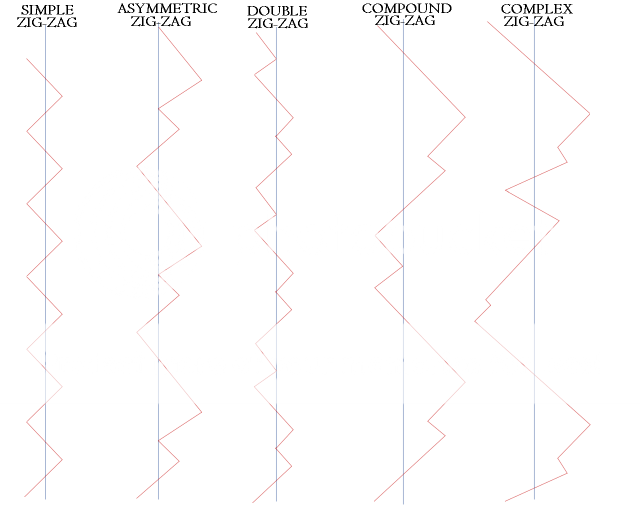
Simple Zig-Zag
A Simple Zig-Zag is a single symmetric zig followed by a mirror image zag, which repeats. This has -1 Small Modifier to solve. Roll 01-10 on d% for the enemy to be using this pattern.
Asymmetric Zig-Zag
An Asymmetric Zig-Zag is different on each side of the true course. This has a -2 Small Modifier to solve. Roll 11-30 on d% for the enemy to be using this pattern.
Double Zig-Zag
A Double Zig-Zag is symmetric, but composed of two repeating patterns either side of the base line. This has a -3 Small Modifier to solve. Roll 31-70 on d% for the enemy to be using this pattern.
Compound Zig-Zag
A Compound Zig-Zag is an asymmetric, multiple, irregular zig-zag. This has a -4 Small Modifier to solve. Roll 71-90 on d% for the enemy to be using this pattern
Complex Zig-Zag
A Complex Zig-Zag is an asymmetric zig-zag with a long, almost random, periodicity, at multiple angles to the baseline course. This has a -5 Small Modifier to solve. Roll 91-00 on d% for the enemy to be using this pattern.
Reducing Difficulty by Observation
You can reduce the penalties to figure out a zig-zag pattern by repeated periscope or other range-and-bearing observations over time. The observations need to be taken from different positions along the base course. The Approach Officer needs to roll a successful Observation check through either the periscope or other range-and-bearing equipment at each observation. Each successful observation - before rolling Tactics - up to the third reduces the modifier by one Small Modifier. Stating that the Assistant Approach officer is rolling a Tactics at any time puts the submarine at a firing point, and an unsuccessful roll means a blown attempt, far out of position.
Night Modifiers are -2 Large for dark nights, -1 Large for bright nights.
Avoiding Escorts
Generally, both merchant convoys and large warship groups are surrounded by escorts - destroyers or other Anti-Submarine Warfare (ASW) craft - patrolling various arcs around the main body, looking for you. There are several standard tactics to slip inside this ring of protection:
Hit ‘Em Where They Ain’t
By timing the escorts’ patterns, the submarine attempts to slip between two escorts at the most opportune time. The Approach Officer must make a successful Observation check with a penalty of 2 Small.
Dig Under the Fence
Using thermoclines - layers of cold water that tend to reflect SONAR pings - the submarine attempts to slip directly under an escort. The escort has -3 Small Modifiers to success in Acquiring a sub under the thermocline - if such a thermocline exists.
A thermocline can be located by the sub’s Signals Officer with a successful Acquisition check and 3 or more successes.
Using Geography
The submarine lies is wait just awash in shallow water at a headland on the coast or an island which the convoy must round. When the escorts all go to seaward to protect the convoy, the conviy lies open to the sub. Of course if anyone sees the sub, it will be helpless sitting there in shallow water. The Navigator may make a Tactics check to find such a place, with each success meaning a better ambush site.
Look! Behind You!
If working with another sub in a wolf pack or a duo, one sub attacks an escort on the other side of the convoy, drawing the other escorts from the unengaged side, clearing the way for the second submarine.
I’m One of You!
With a large number of escorts on a dark night, the submarine slips into the ring of escorts, acting like one of them, before cutting into the ring and attacking. Of course if the escorts aren’t fooled, the sub is a sitting duck.
The Rush
Going in at night on the surface, the submarine sinks one of the lead escorts and goes through the gap, right through the convoy from front to rear, raising chaos in its wake. If this works, it can shatter the convoy. If it doesn’t...

-clash

Saturday, September 17, 2011

IHW: Pigboats VCS - The Final Cut

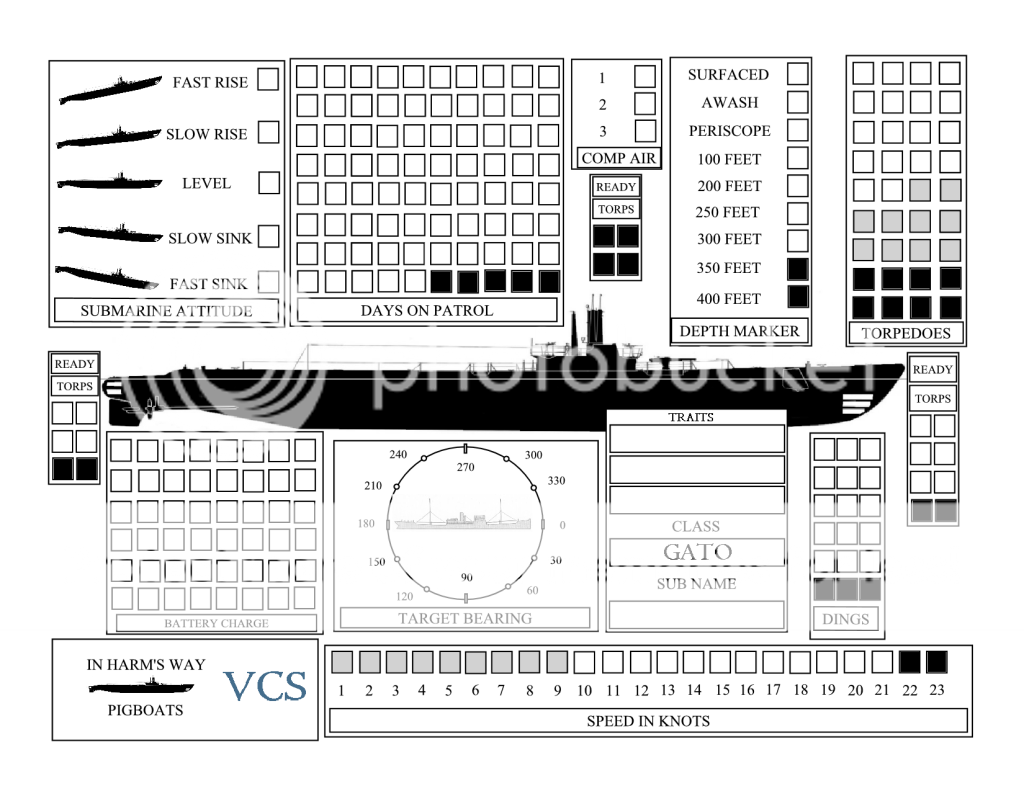
A Vehicle Control Sheet is like a character sheet for the vehicle. By manipulating the items on the sheet, you control the vehicle. Here is an example VCS for a Gato Class Submarine, with explanations to follow:


Submarine Attitude


This is the pitch of the sub - nose up, level, nose down. Use a token and move it over the current attitude.


Days On Patrol


This is the the track for both fuel and food. Blacked in squares are unusable. A Gato has a very long cruising period - 75 days - so there are very few blocked off. Cross off each day you are on patrol.


Compressed Air


Compressed air is used for many purposes, but three in particular are vital - blowing ballast tanks to rise up, Releasing some overboard with some oil to trick an escort into thinking it made a kill, and refreshing air when running silent. You have 3 uses of compressed air. Whenever you use it, check off a box. You can recharge compressed air whenever you are surfaced for at least 30 minutes.


Depth Marker


This shows how deep you are. Use a token and slide it to show your current depth. The black boxes are those past your test depth - the Gato has a test depth of 300 feet. You can go past your test depth, but you run a high risk of springing leaks or imploding. The pressures down here are immense. A hole the size of a pea can produce a water jet powerful enough to cut a man in half.


Torpedoes


This shows how many used torpedoes you have available. The gray boxes are those already loaded in the tubes and indicated elsewhere. When you load a torpedo into a tube, cross it off here. The Gato carries 28 torpedoes, 10 of which are already loaded in the tubes.


Ready Torps


These are your torpedo tubes - each open box represents a tube. Blacked out boxes do not represent tubes. When you fire a torpedo tube, cross off the box. When you reload a tube, erase the x. Tubes can be located one of three places - at the bow, amidships, or aft. The Gato has six tubes in the bow, none amidships, and four in the stern.


Battery Charge


This is your battery charge. Each box is enough power to move the boat at 2 knots underwater for one hour. The Gato's batteries can keep the boat going at this rate for 48 hours underwater without being exhausted. The faster you go, the more quickly you use up energy. Consult the chart as to the exact rate.


Target Bearing


This is a mini bearing chart you can use for targeting if you are not using the big Target Bearing/Range chart. Use tokens to indicate contact bearings.


Identification Block


This block is used for information about the sub - the boat's traits, Class, and name. Write in the boat's traits at top, and the name on the bottom. Each class has its own VCS, with the class pre-printed.


Dings


These boxes represent damage to the sub. Cross off a box for each ding taken from depth charges, shells, or bombs. Some dings can be immediately repaired by Damage Control, so only mark off dings that were not contained. A Gato is tough, and can take up to 15 such dings before it begins sinking from damage.


Speed In Knots


This is a speed track. Use a token to mark the current speed. The blacked out boxes are inaccessible, marking the maximum surface speed, while the gray boxes indicate underwater speed - the marker cannot move into the white boxes while underwater. The Gato subs could go up to 21 knots on the surface, and a maximum of 9 knots underwater.


-clash

Friday, September 16, 2011

Tracking Convoys in IHW: Pigboats

Here's the Target Bearing /Range Chart:


The long oval in the center represents your submarine. The rest of the chart displays how far away and in what direction a contact is. Use tokens for contacts, as they will move.


As the sub moves toward the contact - and/or the contact moves towards the sub -the target moves into a new, closer range band. When the sub and contact move away from each other, the contact moves into a further off range band. As the contact comes closer, it should begin to resolve into separate contacts - first for the larger ships, then for the smaller ships. If your sub is in the middle of a convoy, having penetrated the escort, you might have contacts all around your sub.


The bearing is the relative angle from your sub to the contact. The chart is split into 90 degree quadrants, so zero degrees on the bow means straight ahead, while zero degrees astern means directly behind you. From zero, the degrees increase to 90 degrees to the right and left, then decrease back to zero. Right and left are always relative to zero on the bow, even when talking about bearings astern. So, to place a marker at "40 degrees on the right bow", find zero degrees on the bow and move the marker clockwise to forty degrees. For "40 degrees right astern", find zero degrees astern, and move the marker counter-clockwise forty degrees.


If the sub changes its own course, move the contacts the same number of degrees. For example, you get a contact at 20 degrees on the left bow. The captain decides to turn towards the contact to lessen the range and investigate. Move the contact to zero degrees on the bow and begin stepping the range in.


-clash

Thursday, September 15, 2011

Mo' IHW: Pigboats Character stuff

So - this is where I am. However it occurs - point auction, election, funny dances, mime performances, whatever - you end up with the following:

One Skipper - a Lieutenant Commander with zero Notice. A bit older than the other officers (age 34), he is also more skilled, though his physical Attributes have degraded a skosh.

One XO - A senior Lieutenant, he starts with 200 Notice, and at age 30, he is competent enough to take charge in an emergency, though he doesn't rate being the Skipper by rank.

Two other Lieutenants, age 28, with zero Notice. They hope to become XOs eventually, and one day, if they are lucky and skillful, they may attain the holy rank of Skipper. They are competent enough, but they are still young.

Two Lt. jgs (Lieutenant, junior grade), age 26, with zero Notice. They are not mere Ensigns any more, and are vastly proud of this accomplishement. They consider themselves old and wise in the ways of the world. The Lieutenants are amused by them.

Two Ensigns, age 24, with zero Notice. Fresh-faced kids just out of College, Submarine, and Command School, they think they know what to do and are destined for savage disappointment and much skull thumping learning ahead. No one would trust them to mind a watch on their own. They are probably not trusted to find their arse in the dark with both hands.

From this raw material, the Skipper assigns roles, both in battle and out of combat. A Lieutenant, because of his skill set, might be both Navagator out of combat, and Signals Officer in combat. The Skipper might assign himself the role of Approach Officer, manning the periscope or TBT (Target Bearing Transmitter) while his XO is the Assistant Aproach Officer, familiar with the ways of the TDC (Torpedo Data Computer), and able to predict the chase's zig-zag path and plot a course to put the sub in the most favorable attack position. Or he may switch and let the XO or a Lieutenant make those obsevations and keep the big picture in his head using the TDC.

Every Officer has a role to play in combat. The Approach Officer may shout "Fire One!", but the result is a team effort.

-clash

Monday, September 12, 2011

In Harm's Way: Pigboats - Rank Auction 2

It's looking like rank auctioning is not a popular option, based on feedback here and on Google+. I do *not* want to force this down anyone's throat, but in this game, older means more skills and lower stats, and higher rank means older. I want to give players a chance to come in at the rank they want, without crippling them, and without putting jealousies and anger into play.

In my many military games, I have found no one gets jealous of another player character getting a higher rank if they think that player earned it. Up til now, I have been tending to bring PCs in at the same rank, and letting them earn their rank, but I was hoping to get a shortcut, so I can have a submarine start out with a PC in charge, rather than an NPC. The sub's skipper gets to "squeeze the pickle" - i.e. aim and fire the torpedoes - so starting out with an NPC skipper sort of cuts down harshly on the fun.

Maybe I should just use point buy points, cut out the optional random generation, and chalk the stat loss up to aging. i could do that, but that's boring... :D

-clash

IHW: Pigboats - Rank Auction

Went through what I have written so far, and - as I feared - Bonni was right to warn me. The captain was doing too much and the other officers too little. If it wasn't the captain doing it, it was the ratings, and while in a game with troupe play that is cool, Pigboats is not all about the troupe play. I have to go through and assign stuff to officers, even if they aren't actually doing the work. Example - Hydrophone contact, range and bearing. That is the Sonarman's work, but with this setup, it's the Signals Officer that should roll for it.

So I'm wondering - should I have a rank auction at the beginning of the game? Amber has a stat auction. I'm thinking you could bid on taking higher rank by taking on complications. "Bad relations with CO." "In love with fellow officer's wife." "Secret alcoholic." etc. Each complication having a different point value. Whaddya think?

-clash

Friday, September 9, 2011

IHW: Pigboats - Focusing Tighter

I was initially going to allow the submarines in IHW: Pigboats to be from a range of countries - The UK, Germany, The USA, Japan, Italy, and the Netherlands, like I did the pilots in IHW: Aces In Spades and IHW: Aces And Angels. I have decided to forget about that. I may cover a nation at a time in supplements, if it comes to that, but for the released game I will focus on the US Navy and the Pacific war - the US subs were pretty much non-entities in the Atlantic.

Why? Because I can do some interesting things if the scene is limited. I can - for example - craft a mission generator with specificity, changing the locales offered as the war goes on, with new operating areas opening up and new forward bases established. I can make a generator for situations during the R&R period between missions. I can allow add-ons to the subs - the US subs were refitted after each mission with new and better gear. I can make a much better, more focused target selection. I don't have to account for the differences between the small Japanese convoys and the enormous Allied ones, or between Allied and Axis escort gear and tactics.

This is a pretty important decision for me. I've been agonizing over it for days, but it will be better in the long run, I think.

-clash